
Dr. Moxit Shah, DM Endocrinologist in Ahmedabad
Vishuddha Diabetes, Thyroid & Endocrinology Clinic
📍 104–105, Elite Magnum, Bhuyangdev Cross Road, Vardhmannagar Society, C.P. Nagar-1, Ahmedabad
📞 +91 99799 92797
Introduction
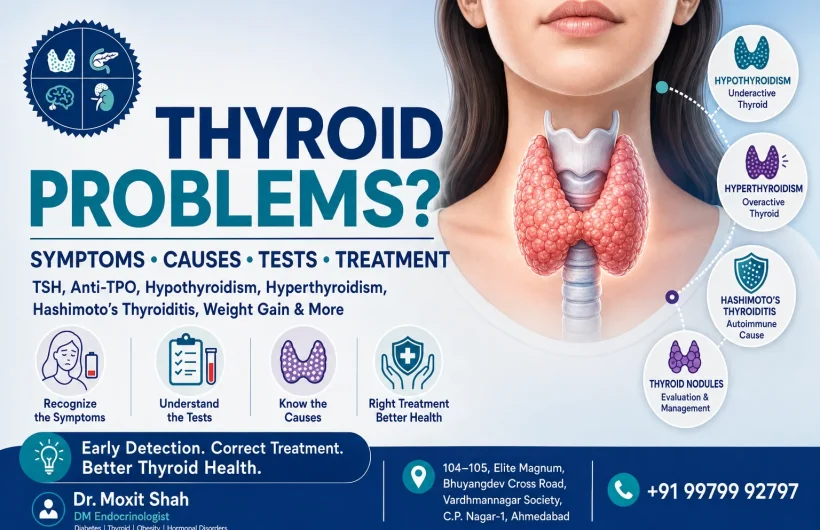
The thyroid is a small butterfly-shaped gland in the neck, but it has an important role in maintaining many functions of the body.
Patients commonly visit an endocrinologist with questions such as:
- “My TSH is high. Do I have thyroid?”
- “Why am I gaining weight?”
- “My Anti-TPO is positive. Is it dangerous?”
- “Do I need thyroid medicine for life?”
- “Why am I tired all the time?”
- “Can thyroid problems cause hair fall?”
- “My thyroid report is normal, but I still have symptoms.”
- “Can I lose weight after treating hypothyroidism?”
Thyroid disorders are common, but thyroid blood reports are often misunderstood.
The most important thing to remember is:
A thyroid diagnosis should not be made from one number alone. TSH, Free T4, symptoms, examination and the clinical situation need to be interpreted together.
This article explains the most common thyroid problems, their symptoms, causes, thyroid blood tests, Anti-TPO antibodies, thyroid-related weight gain and treatment options.
What Is the Thyroid Gland?
The thyroid is a butterfly-shaped endocrine gland located at the front of the neck.
It produces thyroid hormones, primarily thyroxine (T4) and triiodothyronine (T3).
These hormones influence:
- Energy expenditure
- Metabolism
- Heart rate
- Body temperature
- Brain function
- Muscle function
- Digestion
- Growth and development
- Reproductive health
The thyroid works closely with the pituitary gland through the hypothalamic-pituitary-thyroid axis.
A simplified pathway is:
Hypothalamus
↓ TRH
Pituitary gland
↓ TSH
Thyroid gland
↓ T4 and T3
Body tissues
This feedback system helps maintain appropriate thyroid hormone levels.
What Are the Most Common Thyroid Disorders?
Thyroid disease can take several forms.
The common conditions include:
1. Hypothyroidism
The thyroid does not produce enough thyroid hormone.
2. Hyperthyroidism
The thyroid produces excessive thyroid hormone.
3. Hashimoto’s thyroiditis
An autoimmune thyroid disorder that can eventually cause hypothyroidism.
4. Graves’ disease
An autoimmune condition that commonly causes hyperthyroidism.
5. Thyroid nodules
Lumps or growths within the thyroid gland.
6. Goiter
An enlarged thyroid gland.
7. Thyroiditis
Inflammation of the thyroid, which may be temporary or persistent depending on the cause.
What Is Hypothyroidism?
Hypothyroidism occurs when the thyroid gland cannot produce enough thyroid hormone for the body’s needs.
One of the most common causes is Hashimoto’s thyroiditis, an autoimmune condition.
Other causes can include:
- Previous thyroid surgery
- Radioactive iodine treatment
- Certain medications
- Iodine imbalance
- Thyroiditis
- Congenital thyroid disorders
- Pituitary or hypothalamic disease in less common situations
What Are the Symptoms of Hypothyroidism?
Common symptoms may include:
- Tiredness
- Feeling cold
- Weight gain
- Constipation
- Dry skin
- Hair changes
- Muscle aches
- Reduced energy
- Difficulty concentrating
- Low mood
- Slow heart rate
- Menstrual irregularities
However, these symptoms are not specific to hypothyroidism.
For example, fatigue and hair loss can also occur because of iron deficiency, poor sleep, stress, nutritional problems and several other conditions.
Therefore, symptoms alone cannot diagnose hypothyroidism.
Can Hypothyroidism Cause Weight Gain?
Yes—but usually not as much as people think.
Hypothyroidism can contribute to weight gain because thyroid hormone deficiency can reduce energy expenditure.
However, thyroid-related weight gain is often accompanied by fluid and salt retention, and the amount of weight gain varies between individuals.
If someone has significant obesity, hypothyroidism is usually not the only explanation.
Other factors may include:
- Calorie intake
- Physical activity
- Sleep
- Insulin resistance
- Diabetes
- PCOS
- Menopause
- Medications
- Genetics
- Obesity-related biological mechanisms
This is why simply increasing thyroid medicine is not an appropriate weight-loss strategy.
Why Am I Not Losing Weight Even Though My Thyroid Is Normal?
This is one of the most common questions in endocrinology.
If you have hypothyroidism and take levothyroxine, your TSH may eventually return to the appropriate range.
But your weight may remain elevated.
That does not necessarily mean that your thyroid treatment has failed.
Once thyroid hormone levels are appropriately corrected, persistent obesity should be evaluated as a separate metabolic problem.
Depending on the individual patient, treatment may involve:
- Nutrition
- Physical activity
- Sleep optimization
- Management of diabetes or prediabetes
- Treatment of associated conditions
- Behavioral strategies
- Evidence-based anti-obesity medication when appropriate
What Is TSH?
TSH stands for thyroid-stimulating hormone.
It is produced by the pituitary gland and regulates thyroid hormone production.
TSH is one of the most important blood tests used to assess thyroid function.
In primary hypothyroidism:
Low thyroid hormone
↓
Less negative feedback
↓
TSH rises
This is why an elevated TSH commonly suggests an underactive thyroid, particularly when accompanied by a low Free T4.
What Is Free T4?
Free T4 represents the circulating unbound fraction of thyroxine available to tissues.
TSH and Free T4 are generally interpreted together.
For example:
| TSH | Free T4 | Possible interpretation |
|---|---|---|
| High | Low | Overt primary hypothyroidism |
| High | Normal | Subclinical hypothyroidism |
| Normal | Normal | Usually euthyroid |
| Low | High | Hyperthyroidism |
| Low | Normal | Requires clinical interpretation |
This table is a simplified framework. Age, pregnancy, medications, illness and pituitary disease can affect interpretation.
What Does a High TSH Mean?
A high TSH does not automatically mean that every patient needs treatment immediately.
The interpretation depends on:
- How high the TSH is
- Free T4
- Age
- Symptoms
- Pregnancy
- Pregnancy planning
- Thyroid antibodies
- Cardiovascular risk
- Previous thyroid tests
- Other medical conditions
A mildly elevated TSH with normal Free T4 is generally called:
Subclinical hypothyroidism
A high TSH with low Free T4 is:
Overt hypothyroidism
These conditions should not be managed in exactly the same way.
What Is Anti-TPO?
Anti-TPO stands for anti-thyroid peroxidase antibody.
Thyroid peroxidase is an enzyme involved in thyroid hormone production.
In autoimmune thyroid disease, the immune system can mistakenly recognize thyroid proteins as targets.
The resulting autoimmune response can produce antibodies such as Anti-TPO.
Therefore:
Anti-TPO positivity is a marker of thyroid autoimmunity.
It is strongly associated with Hashimoto’s thyroiditis.
But Anti-TPO positivity does not automatically mean that the thyroid is currently underactive.
Why Does Anti-TPO Become Positive?
The development of Anti-TPO involves several interacting factors.
Genetic susceptibility
Some individuals are genetically more susceptible to autoimmune disease.
↓
Loss of immune tolerance
The immune system loses appropriate tolerance to thyroid proteins.
↓
Thyroid antigen recognition
TPO and other thyroid proteins become targets of the immune response.
↓
T-cell activation
Thyroid-reactive T cells become activated.
↓
B-cell activation
B cells receive signals from helper T cells.
↓
Plasma-cell formation
B cells differentiate into antibody-producing plasma cells.
↓
Anti-TPO production
Anti-TPO antibodies become detectable in the blood.
In Hashimoto’s thyroiditis, T-cell-mediated immune injury also contributes substantially to progressive thyroid follicular-cell damage.
Does a High Anti-TPO Mean Severe Thyroid Disease?
Not necessarily.
This is a very important misconception.
A person may have:
Anti-TPO >1,000
while having:
Normal TSH + normal Free T4
Another person may have a lower Anti-TPO level but already have significant hypothyroidism.
Therefore:
The Anti-TPO number is not a direct measure of thyroid function.
TSH and Free T4 are much more important when determining whether the thyroid is functioning adequately.
Anti-TPO Positive but TSH Normal: What Does It Mean?
This is a very common situation.
A patient may have:
Anti-TPO positive
TSH normal
Free T4 normal
This means there is evidence of thyroid autoimmunity, but thyroid hormone production is currently adequate.
Some people remain euthyroid for many years.
Others eventually develop hypothyroidism.
Therefore, appropriate follow-up of thyroid function may be recommended.
Do you need thyroid medicine just because Anti-TPO is positive?
Not necessarily.
Treatment decisions should be based on thyroid function and the individual clinical situation—not the antibody result alone.
Should Anti-TPO Be Repeated?
Usually, routine repeated measurement of Anti-TPO is not necessary.
Once positivity has been established, repeatedly checking whether the antibody number has gone from:
1,000 → 700 → 500
does not necessarily tell us whether thyroid function has improved.
For monitoring thyroid function, TSH and Free T4 are generally much more useful.
What Is Hashimoto’s Thyroiditis?
Hashimoto’s thyroiditis is an autoimmune disease of the thyroid.
The immune system reacts against thyroid tissue, producing chronic inflammation.
Over time, thyroid follicular cells may become damaged.
The sequence can be simplified as:
Autoimmune response
↓
Chronic thyroid inflammation
↓
Follicular-cell injury
↓
Reduced thyroid reserve
↓
Hypothyroidism
Hashimoto’s is one of the most common causes of hypothyroidism.
What Is Hyperthyroidism?
Hyperthyroidism occurs when the body has excessive thyroid hormone activity.
Common symptoms include:
- Weight loss
- Palpitations
- Tremor
- Excess sweating
- Heat intolerance
- Anxiety
- Increased bowel movements
- Muscle weakness
- Difficulty sleeping
- Menstrual changes
Common causes include:
- Graves’ disease
- Toxic thyroid nodules
- Toxic multinodular goiter
- Thyroiditis
- Excess thyroid hormone intake
What Is Graves’ Disease?
Graves’ disease is an autoimmune condition that stimulates the thyroid gland to produce excess thyroid hormone.
The important antibody is generally the:
TSH receptor antibody (TRAb)
or related stimulating antibody such as:
TSI
Unlike Anti-TPO, these antibodies directly stimulate the TSH receptor.
This distinction is important when interpreting thyroid antibody reports.
Thyroid Nodules: Should You Be Worried?
A thyroid nodule is a lump within the thyroid gland.
Many thyroid nodules are benign.
However, some require further assessment.
Evaluation may include:
Clinical examination
↓
TSH
↓
Thyroid ultrasound
↓
Ultrasound risk assessment
↓
Follow-up or fine-needle aspiration when indicated
A biopsy is not automatically required for every thyroid nodule.
The decision depends on factors such as nodule size, ultrasound characteristics and clinical risk factors.
Can Thyroid Nodules Cause Weight Gain?
Usually, no.
Most thyroid nodules do not significantly affect thyroid hormone production.
A person can have:
Thyroid nodule + normal thyroid function
Therefore, if you have a thyroid nodule and weight gain, thyroid function should be assessed separately rather than assuming that the nodule is causing the weight gain.
Thyroid and Pregnancy
Thyroid function becomes particularly important during pregnancy.
Thyroid hormone is important for maternal health and fetal development.
Women with:
- Known hypothyroidism
- Hashimoto’s thyroiditis
- Positive Anti-TPO
- Previous postpartum thyroiditis
- Previous thyroid surgery
- Thyroid dysfunction during a previous pregnancy
may require closer thyroid-function monitoring.
If you have thyroid disease and are planning pregnancy, discuss your thyroid treatment with your endocrinologist before conception whenever possible.
Thyroid and Hair Fall
Hair loss is frequently blamed on thyroid disease.
Hypothyroidism and hyperthyroidism can both be associated with hair changes.
However, hair loss has many other causes, including:
- Iron deficiency
- Nutritional deficiencies
- Stress
- Recent illness
- Hormonal changes
- Androgenetic hair loss
- Certain medications
Therefore:
Hair fall + positive Anti-TPO does not automatically mean that Anti-TPO is causing the hair loss.
The underlying cause should be assessed.
Thyroid and GLP-1 Medicines
With the increasing use of semaglutide and tirzepatide for obesity and diabetes, patients with thyroid disease often ask:
“Can I take a GLP-1 medicine if I have thyroid disease?”
Having common thyroid conditions such as hypothyroidism or Hashimoto’s thyroiditis does not automatically mean that GLP-1-based treatment is unsuitable.
However, these medicines carry an important thyroid-related warning concerning medullary thyroid carcinoma (MTC) and multiple endocrine neoplasia type 2 (MEN2).
This is different from ordinary hypothyroidism or Hashimoto’s thyroiditis.
Therefore, patients considering GLP-1 treatment should discuss their medical and family history with their doctor.
Thyroid Treatment: Does Everyone Need Medicine?
No.
Treatment depends on the underlying thyroid condition.
Hypothyroidism
The usual treatment is levothyroxine, when thyroid hormone replacement is indicated.
Hyperthyroidism
Treatment may include:
- Antithyroid medicines
- Radioactive iodine
- Surgery
depending on the cause and patient characteristics.
Thyroiditis
Some forms are temporary and may require supportive treatment rather than lifelong thyroid hormone replacement.
Thyroid nodules
Management may range from observation to biopsy, surgery or other treatment depending on the clinical and ultrasound findings.
Is Thyroid Medicine Lifelong?
Not always.
It depends on the cause.
For example, people with permanent autoimmune hypothyroidism or thyroid removal often require long-term thyroid hormone replacement.
However, some thyroid problems are temporary.
Examples include certain forms of thyroiditis.
Therefore:
Do not assume that every person who starts thyroid medicine will need it for life.
The underlying diagnosis matters.
How Should Levothyroxine Be Taken?
Levothyroxine absorption can be affected by food and certain medications or supplements.
Patients should take it consistently according to their doctor’s instructions.
Calcium and iron supplements, for example, can interfere with absorption when taken too close to levothyroxine.
After starting or changing the dose, TSH is generally reassessed after an appropriate interval.
Do not increase, decrease or stop thyroid medicine without discussing it with your doctor.
10 Common Thyroid Myths
Myth 1: “I have thyroid.”
Fact: There are several different thyroid disorders. A person may have hypothyroidism, hyperthyroidism, thyroiditis, nodules or another thyroid condition.
Myth 2: “Every high TSH needs immediate lifelong medicine.”
Fact: Treatment depends on the degree and cause of thyroid dysfunction and the individual clinical situation.
Myth 3: “High Anti-TPO means severe hypothyroidism.”
Fact: Anti-TPO indicates thyroid autoimmunity; it does not directly measure thyroid function.
Myth 4: “Anti-TPO positive means I will definitely become hypothyroid.”
Fact: The risk is increased, but hypothyroidism is not inevitable.
Myth 5: “Thyroid medicine is a weight-loss medicine.”
Fact: Thyroid hormone should not be used as a weight-loss drug.
Myth 6: “A thyroid nodule means cancer.”
Fact: Most thyroid nodules are benign.
Myth 7: “All weight gain is due to thyroid.”
Fact: Weight regulation is influenced by multiple metabolic, lifestyle, genetic and hormonal factors.
Myth 8: “If my TSH is normal, thyroid disease is impossible.”
Fact: Interpretation depends on the clinical situation. Structural thyroid problems such as nodules can occur despite normal thyroid function.
Myth 9: “I need to repeatedly check Anti-TPO.”
Fact: TSH and Free T4 are generally more useful for monitoring thyroid function.
Myth 10: “Natural thyroid supplements are always safer.”
Fact: Unregulated thyroid or iodine-containing products can be inappropriate or harmful.
When Should You See an Endocrinologist?
You should consider an endocrinology consultation if you have:
- Abnormal TSH
- Abnormal Free T4
- Positive Anti-TPO with thyroid abnormalities
- Persistent unexplained weight gain
- Symptoms suggesting hypothyroidism
- Symptoms suggesting hyperthyroidism
- Thyroid swelling
- A thyroid nodule
- Difficulty controlling thyroid levels
- Thyroid disease during pregnancy
- Thyroid disease while planning pregnancy
- A personal or family history of thyroid disease
- Questions about thyroid and GLP-1 medicines
Frequently Asked Questions About Thyroid Disease
What is the most common thyroid problem?
Hypothyroidism is one of the most common thyroid disorders. Hashimoto’s thyroiditis is an important cause of primary hypothyroidism.
What TSH level means I have thyroid?
There is no single number that should be interpreted without context. TSH should be interpreted with Free T4, symptoms, age, pregnancy status and other clinical factors.
Can thyroid cause weight gain?
Hypothyroidism can contribute to weight gain, but significant obesity usually has multiple contributing factors.
Is Anti-TPO positive dangerous?
Anti-TPO positivity indicates thyroid autoimmunity. It does not automatically mean that the thyroid is currently failing.
Can Anti-TPO be positive with normal TSH?
Yes. A person can have thyroid autoimmunity while remaining euthyroid.
Should I take thyroid medicine if Anti-TPO is positive?
Not necessarily. Treatment depends primarily on thyroid function and the clinical situation.
Can thyroid nodules be cancerous?
Yes, some can be, but most thyroid nodules are benign. Appropriate ultrasound-based risk assessment is important.
Can I take Mounjaro or Ozempic if I have hypothyroidism?
Hypothyroidism alone does not automatically prevent use of these medicines. However, individual medical history and specific contraindications should be reviewed by your doctor.
Key Takeaway
The thyroid affects metabolism, energy, cardiovascular function, temperature regulation and many other processes in the body.
But not every symptom is caused by the thyroid, and not every abnormal thyroid antibody requires treatment.
Remember the basic distinction:
TSH + Free T4 → Thyroid function
Anti-TPO → Thyroid autoimmunity
Ultrasound → Thyroid structure
Symptoms + examination → The patient as a whole
The correct diagnosis comes from putting all of these pieces together.
If you have an abnormal thyroid report, avoid self-medication and avoid changing your thyroid medicine based on a single laboratory result.
Consult Dr. Moxit Shah – DM Endocrinologist in Ahmedabad
Dr. Moxit Shah
DM Endocrinologist
Specialist in:
Diabetes • Thyroid Disorders • Obesity & Medical Weight Management • Endocrinology
Vishuddha Diabetes, Thyroid & Endocrinology Clinic
📍 104–105, Elite Magnum, Bhuyangdev Cross Road, Vardhmannagar Society, C.P. Nagar-1, Ahmedabad
📞 +91 99799 92797